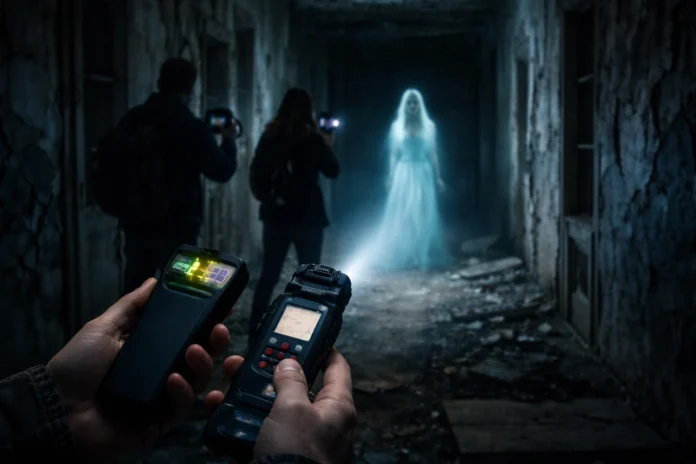
Paranormal research lives in the narrow space between curiosity and discipline. It attracts storytellers, thrill-seekers, skeptics, and believers in equal measure—and too often, it collapses into spectacle. What sets Marq English apart is a refusal to treat the unknown as entertainment first. His approach is slower, more methodical, and grounded in an old-fashioned idea that has fallen out of favor in the paranormal world: evidence matters.
English approaches investigations the way a field researcher would approach unfamiliar terrain. Locations are studied before boots ever hit the floor. Historical records, property changes, prior renovations, and documented events are reviewed not to confirm a haunting, but to understand the environment. Context comes first. Without it, strange noises and odd readings are just noise layered on ignorance.
Technology plays a role in his work, but it is never treated as magic. Audio recorders, environmental sensors, EMF meters, and thermal cameras are tools—not truth machines. English is careful to remind collaborators and audiences alike that devices measure conditions, not intent. An electromagnetic spike doesn’t announce a ghost any more than a Geiger counter announces a conversation. The data only becomes meaningful when it’s repeatable, contextual, and resistant to easy explanations.
One of the most overlooked aspects of paranormal research is the human factor, and this is where English is particularly cautious. Fatigue, expectation, fear, and suggestion can distort perception faster than any malfunctioning device. Long nights in unfamiliar spaces prime the brain to fill gaps with stories. English treats witness accounts and investigator experiences with respect, but also with restraint. Personal experience is acknowledged—but never allowed to outrun verification.
Audio research, especially so-called EVP recordings, is another area where his restraint shows. Rather than immediately labeling ambiguous sounds as voices, English documents ambient conditions: air movement, nearby traffic, electrical interference, and building acoustics. Sounds are isolated, cataloged, and compared across sessions. If something cannot be replicated or reasonably explained, it is marked as unresolved—not paranormal by default. Uncertainty is not failure; it’s honesty.
Perhaps the most defining feature of English’s work is his comfort with not knowing. In a field crowded with certainty and dramatic conclusions, he leaves space for ambiguity. Some locations produce nothing at all. Others produce anomalies that resist explanation without demanding belief. That middle ground—the unresolved—is where genuine research lives. It’s less marketable, but far more credible.
Researching the paranormal responsibly requires patience, skepticism, and humility. It demands resisting the urge to turn mystery into myth too quickly. Marq English operates with the understanding that the unknown does not owe us answers, and forcing conclusions only muddies the waters. In a world eager for ghosts on demand, his work stands as a reminder that the strangest thing we can do is slow down, document carefully, and admit what we don’t yet understand.
That restraint doesn’t kill wonder. It preserves it.