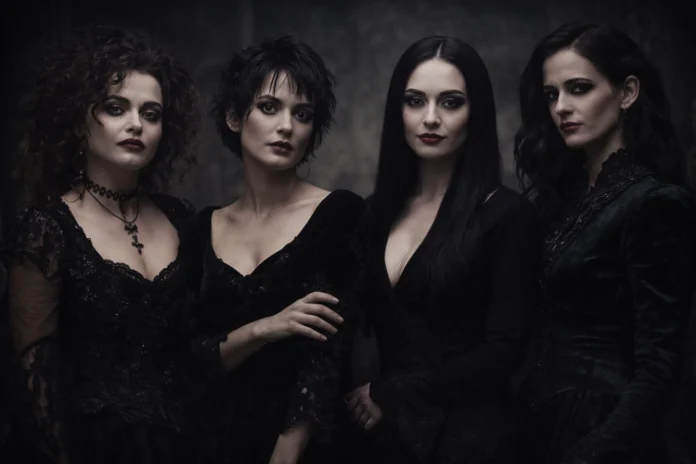
Hollywood has always been obsessed with brightness—youth, smiles, optimism, polish. Yet running beneath that glare is a darker current, one carried for decades by women who refused to soften their edges. The Gothic women of Hollywood didn’t just wear black; they reshaped how mystery, power, and femininity could exist on screen. They reminded audiences that beauty doesn’t need to be cheerful to be compelling.
Gothic Hollywood isn’t about costumes alone. It’s a posture. A refusal to over-explain. A comfort with shadows—emotional, aesthetic, and psychological. These women didn’t chase likability. They cultivated presence.
Few embody this better than Helena Bonham Carter, whose career thrives on eccentricity and emotional volatility. Whether portraying tragic lovers, unstable aristocrats, or haunted figures, she leans into imperfection with theatrical intelligence. Her Gothic appeal lies in her unpredictability—she doesn’t smooth out the strange parts. She amplifies them.
In the late 1980s and 1990s, Winona Ryder became the face of introspective darkness. She wasn’t loud or dominant; she was withdrawn, thoughtful, and visibly burdened by inner worlds. Her Gothic presence was quiet, literary, and wounded—less about menace and more about alienation. She gave voice to a generation that felt out of step with its surroundings.
Then there is Christina Ricci, whose portrayal of Morticia Addams as an adult refined Gothic femininity into something elegant and controlled. Morticia is not chaotic or broken—she is self-possessed, sensual, and intellectually superior. Ricci’s Gothic power comes from restraint. Nothing about her performances begs for approval.
More recently, Eva Green has carried the torch into modern cinema. Her roles often blur the line between desire and danger, vulnerability and dominance. Green’s Gothic energy is mythic—she feels less like a contemporary character and more like something summoned. Her presence reminds Hollywood that darkness can be luxurious, cerebral, and deeply feminine.
What unites these women isn’t genre—it’s integrity. Gothic women of Hollywood resist simplification. They don’t exist to reassure the audience. They challenge it. They allow sadness, obsession, intelligence, and sensuality to coexist without apology.
In an industry that constantly pressures women to remain palatable, Gothic icons endure by embracing what others are taught to hide. They prove that darkness isn’t the absence of beauty—it’s a different kind of truth. And Hollywood, despite itself, keeps needing them.