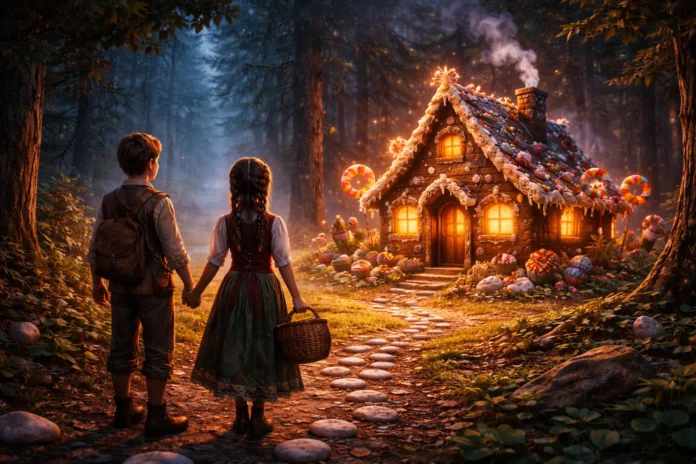
Fairy tales endure because they are honest about danger. Beneath their simple language and sharp imagery, they speak to problems that never go away: hunger, abandonment, temptation, and survival. Few stories make this clearer than Hansel and Gretel—a tale often reduced to candy and witches, but at heart concerned with something far more adult: how desire can mislead us, and how integrity and consistency are what bring us home.
At the beginning of the story, hunger is literal. Scarcity drives fear, and fear drives poor decisions. The parents abandon their children not out of cruelty, but panic. This matters. The tale isn’t interested in villains alone; it’s interested in what happens when people act without integrity under pressure. When care becomes inconsistent, trust collapses. That fracture is the first danger Hansel and Gretel face, long before the forest closes in.
Hansel responds with foresight. He gathers stones. He plans. He repeats what works. Gretel responds with awareness. She adapts. She watches. Together, they demonstrate something the story quietly insists upon: survival is not bravado—it’s consistency. Integrity here is not moral posturing; it’s reliability. They do what they say they’ll do. They stay aligned with each other when the adults in their world fail to stay aligned with them.
Then comes the house of sweets—the most misunderstood symbol in the story. The witch doesn’t trap the children with force. She tempts them. Desire, in this tale, is not evil—but it is dangerous when detached from discernment. The house offers immediate gratification with no visible cost. It promises nourishment without effort, warmth without trust, pleasure without relationship. That is why it works.
This is where the story turns inward and modern. We all recognize that house. It shows up in relationships that feel good but aren’t honest, in attention that flatters but doesn’t endure, in connections that sparkle briefly and then vanish when effort is required. Desire without integrity always looks generous at first. It feeds you just enough to keep you compliant.
The witch’s greatest flaw is not malice—it’s inconsistency. She lies. She manipulates. She changes the rules. And children, contrary to myth, are exquisitely sensitive to inconsistency. Gretel doesn’t defeat the witch with strength; she defeats her by recognizing the pattern. The same awareness applies to adult relationships. When words and actions don’t align, when care appears only when convenient, when promises dissolve under stress—that’s the oven warming up.
Gretel’s final act is not revenge. It’s clarity. She chooses alignment with reality over fear. She chooses truth over temptation. And once the witch is gone, the forest no longer traps them. That’s one of the story’s quietest lessons: the danger was never the woods. It was deception.
When Hansel and Gretel return home, their world has changed—not because the world became safer, but because they did. They return with discernment, shared trust, and the knowledge that consistency builds safety where promises alone cannot.
In modern life, we don’t wander into forests, but we do enter connections—romantic, familial, social—where desire tempts us to ignore misalignment. Hansel and Gretel reminds us that integrity is not dramatic. It’s repetitive. It’s showing up the same way tomorrow as you did yesterday. And consistency, though rarely glamorous, is what turns survival into belonging.